
Accessible portable restrooms aren't optional — they're a legal requirement under federal law. The Americans with Disabilities Act (ADA) establishes specific accessibility standards for temporary sanitation facilities, making compliance knowledge critical for anyone organizing events, overseeing construction, or managing properties in Wichita and Sedgwick County.
At Gigantix Porta Potty Rental Wichita, we've helped hundreds of clients navigate ADA compliance for events in Old Town, festivals near Riverside, and construction projects throughout College Hill and beyond. In this guide, we'll break down everything you need to know about ADA porta potty requirements — from specific dimensions and features to how many you need and what happens if you don't comply.
Understanding ADA Compliance for Portable Restrooms
The Americans with Disabilities Act, signed into law in 1990, is a civil rights law that prohibits discrimination against individuals with disabilities in all areas of public life. Title III of the ADA specifically addresses public accommodations, which includes temporary facilities like portable restrooms at events, festivals, and construction sites.
This means that any time you set up portable restrooms for public use — whether it's a weekend music festival, a corporate gala, a community fundraiser, or a long-term construction project — you're required to include ADA-compliant units. The goal is straightforward: ensure that individuals with disabilities have equal access to sanitation facilities.
The ADA doesn't just apply to permanent structures. Any temporary facility open to the public — including portable restrooms — must meet accessibility standards.
Essential Design Standards for Accessible Portable Units
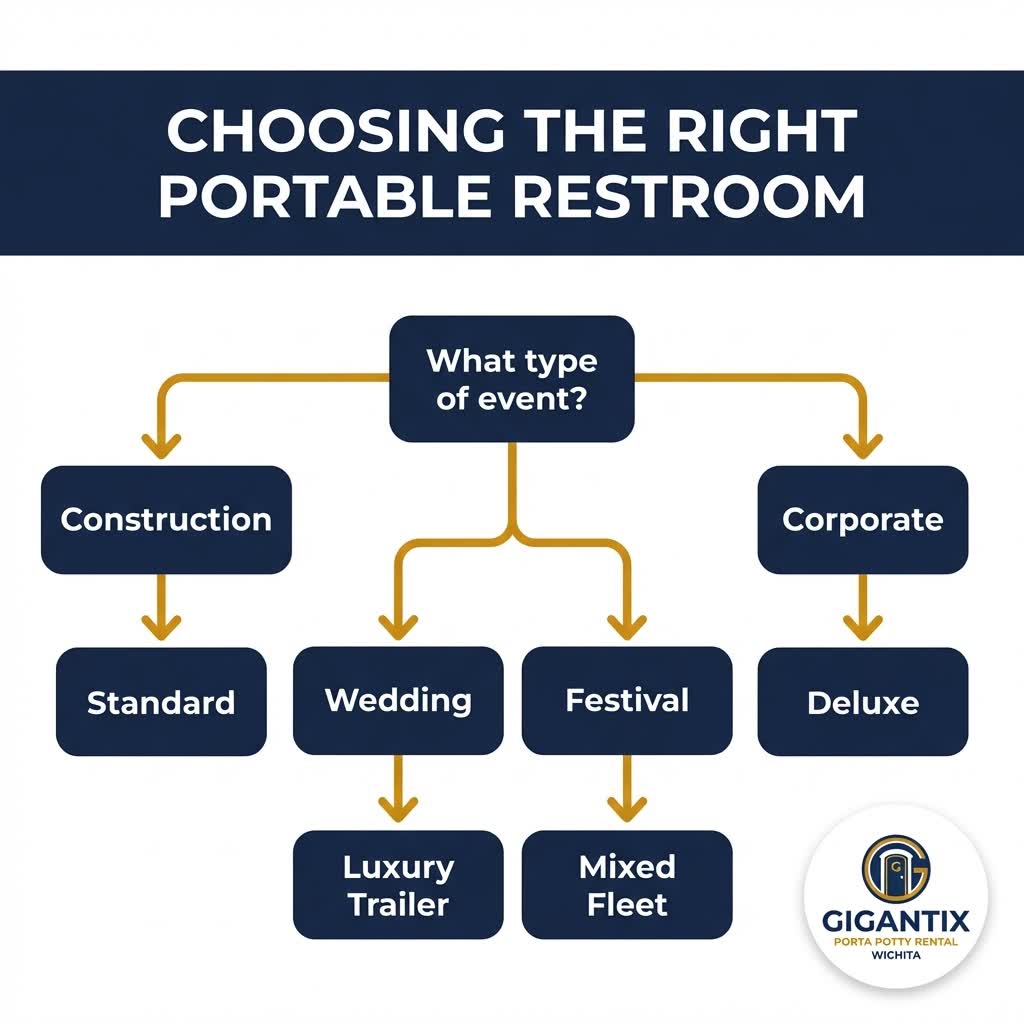
ADA-compliant portable restrooms differ significantly from standard units. Here are the specific physical requirements that must be met:
Interior Dimensions
The most critical requirement is interior space. ADA portable restrooms must provide:
- Minimum floor space of 60" × 60" (5 feet by 5 feet) to allow a full wheelchair turning radius
- Unobstructed floor area free from any obstacles that would impede wheelchair movement
- Minimum ceiling height of 80 inches to accommodate standing transfers and caregiver assistance
Compare this to a standard portable restroom, which typically measures about 44" × 48" inside — far too small for wheelchair access. Our ADA-compliant portable restrooms at Gigantix Porta Potty Rental Wichita exceed these minimums, providing spacious interiors that accommodate wheelchairs, walkers, and caregivers comfortably.
Door Requirements
The door is often the first barrier to accessibility. ADA requirements specify:
- Minimum door width of 32 inches when open (measured from the face of the door to the opposite stop)
- Outward-opening door to maximize interior space and prevent trapping a wheelchair user inside
- Door hardware operable with one hand without tight grasping, pinching, or twisting motions
- Maximum 5 pounds of force required to open the door
Grab Bars
Grab bars are essential for safe transfers between a wheelchair and the toilet seat. ADA standards require:
- Side grab bar on the wall closest to the toilet, at least 42 inches long, mounted 33-36 inches above the floor
- Rear grab bar behind the toilet, at least 36 inches long, at the same height
- 1.25 to 1.5 inch diameter for proper grip
- 1.5 inches of clearance between the bar and the wall
- Must support at least 250 pounds of force
Toilet Seat Height
The toilet seat in an ADA unit must be positioned between 17 and 19 inches above the floor. This height aligns with standard wheelchair seat height, facilitating safer and easier lateral transfers.
Ramp Entry and Ground-Level Access
One of the most overlooked requirements is the entry path. ADA portable restrooms must have:
- A ramp or ground-level entry that allows wheelchair access without assistance
- Ramp slope no steeper than 1:12 (one inch of rise for every 12 inches of horizontal run)
- Edge guards on ramps to prevent wheelchairs from rolling off the sides
- Non-slip surface on the ramp, maintained even in wet conditions
- Level landing at the top of the ramp that is at least 60 inches long
In Kansas, where weather conditions can change rapidly — from spring rain to winter ice — ensuring that ramp surfaces remain safe and accessible is particularly important. Gigantix Porta Potty Rental Wichita provides ramps with textured, slip-resistant surfaces rated for all weather conditions.
Compliance Differences: Events vs. Job Sites
While the core ADA requirements remain the same, there are important distinctions between event and construction site applications.
Public Events and Festivals
For public events — such as the many festivals and gatherings held in Wichita throughout the year — ADA compliance falls under Title III of the ADA. Key considerations include:
- Minimum 5% of all portable restrooms must be ADA-compliant, with at least one unit regardless of total count
- ADA units must be distributed across all restroom clusters, not concentrated in one area
- Accessible route must connect ADA units to the main event area, parking, and other accessible facilities
- Signage with the International Symbol of Accessibility must be posted on or near ADA units
When we deployed units for a corporate gala in downtown Wichita, we placed ADA units at every restroom station and ensured accessible pathways connected them to the main event entrance, parking areas, and dining zones.
Construction Sites
Construction site requirements are governed by both the ADA and OSHA (Occupational Safety and Health Administration). OSHA Standard 29 CFR 1926.51 requires employers to provide sanitation facilities at construction sites. When employees with disabilities are present — or when the public has access to the site — ADA-compliant units are required.
- At least one ADA unit per construction site is recommended as a best practice
- Units must be placed on firm, level ground accessible via the site's pedestrian pathways
- Regular servicing must maintain accessibility features (grab bars secure, ramp clear, door functioning properly)
Our standard portable restrooms handle the high-volume needs of construction sites, while our ADA units ensure you're covered for accessibility compliance.
How Many ADA Porta Potties Do You Need?
The 5% rule is the baseline, but calculating the right number of ADA units depends on your specific situation:
- 1-20 total units: Minimum 1 ADA unit
- 21-40 total units: Minimum 2 ADA units
- 41-60 total units: Minimum 3 ADA units
- 61-80 total units: Minimum 4 ADA units
- 81-100 total units: Minimum 5 ADA units
However, at Gigantix Porta Potty Rental Wichita, we typically recommend exceeding these minimums. ADA units are larger and more comfortable, which means they're popular with all guests — not just those with disabilities. Parents with strollers, elderly attendees, and anyone who appreciates extra space will gravitate toward these units. Having extra ADA units reduces wait times and improves the experience for everyone.
For a large-scale event, consider reading our festival sanitation planning checklist which includes detailed unit count formulas that factor in ADA requirements.
Placement Best Practices for ADA Units
Proper placement of ADA portable restrooms is just as important as having the right quantity. Follow these guidelines:
Distribute Across All Restroom Clusters
Never place all ADA units in a single location. If your event has three restroom stations, each station should include at least one ADA unit. This ensures that guests with disabilities don't have to travel disproportionately far to reach accessible facilities.
Ensure Accessible Pathways
The path from the main event area to each ADA unit must be:
- At least 36 inches wide (44 inches preferred for two-way traffic)
- Firm, stable, and slip-resistant — avoid grass, gravel, or sand when possible
- Free from steps, steep slopes, or abrupt level changes
- Well-lit for evening events
Level Ground Is Essential
ADA units must be placed on level ground. Even a slight incline can make door operation difficult for wheelchair users and compromise the effectiveness of the entry ramp. If your venue has uneven terrain, request ground-leveling platforms from your rental provider.
Proximity to Parking and Entrances
Place at least one ADA restroom cluster near accessible parking areas and event entrances. Guests with mobility challenges often arrive and depart through these areas, so nearby facilities improve convenience and reduce travel distance.
Additional Accessibility Features to Consider
Beyond the minimum requirements, there are several enhancements that can significantly improve the experience for guests with disabilities:
- Portable hand wash stations at wheelchair-accessible height — our portable sink stations include models designed for wheelchair users
- Deluxe flushable units in ADA configurations — our deluxe portable restrooms offer enhanced ventilation and a flushing mechanism in accessible dimensions
- Luxury restroom trailers with built-in ADA stalls — our luxury restroom trailers feature climate-controlled, fully accessible stalls with running water
- Holding tank services for extended events — our holding tank solutions ensure continuous operation during multi-day events
- Interior lighting in all ADA units for safety and visibility
- Tactile signage for visually impaired users
Penalties for ADA Non-Compliance
Failing to provide adequate ADA-compliant restroom facilities carries serious consequences:
Federal Penalties
- First violation: Civil penalties up to $75,000
- Subsequent violations: Up to $150,000 per violation
- Department of Justice enforcement actions can require corrective measures plus damages
State and Local Consequences
In Kansas, additional penalties may apply through state accessibility laws. The City of Wichita may also deny or revoke event permits for facilities that don't meet accessibility requirements. Many venues require proof of ADA compliance as a condition of their rental agreements.
Legal Liability
Beyond government fines, event organizers can face private lawsuits from individuals who were denied accessible facilities. These lawsuits can result in compensatory damages, injunctive relief, and attorney's fees. The reputational damage alone can be devastating for organizations that depend on public trust.
The cost of ADA compliance is minimal compared to the cost of non-compliance. A single lawsuit or fine can exceed what you'd spend on accessible units for years of events.
How Gigantix Porta Potty Rental Wichita Ensures Your Compliance
At Gigantix Porta Potty Rental Wichita, ADA compliance is built into every rental plan we create. Here's how we help:
- Compliance consultation — We assess your event size, venue, and layout to recommend the right number and placement of ADA units
- Quality-inspected units — Every ADA unit is inspected before delivery to ensure all grab bars, ramps, door hardware, and signage meet current standards
- Professional delivery and setup — Our team positions units on level ground, deploys ramps, and verifies accessible pathways
- Regular servicing — Our maintenance crews verify that accessibility features remain functional during the entire rental period
If you're planning a winter event, our winter porta potty rental guide covers how cold weather affects accessibility and what precautions to take during Kansas winters.
Call us at (316) 229-6338 to discuss your ADA compliance needs and get a customized rental plan.
Frequently Asked Questions
The ADA requires that at least 5% of all portable restrooms at a public event be ADA-compliant, with a minimum of one unit. For example, if you have 20 standard units, you need at least one ADA unit. Gigantix Porta Potty Rental Wichita recommends exceeding minimums to ensure comfort and reduce wait times for guests with disabilities.
ADA-compliant portable restrooms must have a minimum interior floor space of 60 inches by 60 inches (5 feet by 5 feet) to allow wheelchair turning radius. The door must be at least 32 inches wide and open outward. Interior grab bars must be installed on at least two walls.
Yes. OSHA regulations require that construction sites with employees who have disabilities must provide accessible sanitation facilities. Even without current disabled employees, many contractors proactively include ADA units to ensure compliance and preparedness.
Penalties for ADA non-compliance can include fines starting at $75,000 for a first violation and up to $150,000 for subsequent violations under federal law. Additionally, event organizers may face lawsuits, permit revocations, and reputational damage.
Yes, ADA-compliant portable restrooms must have a ramp or ground-level entry that allows wheelchair access. The ramp must have a slope no steeper than 1:12 (one inch of rise per 12 inches of length) and include edge guards to prevent wheelchairs from rolling off.

Brett Sullivan
Brett has over 15 years of experience in the portable sanitation industry. He founded Gigantix Porta Potty Rental Wichita with a mission to deliver reliable, clean, and professional restroom solutions to the Wichita community. Brett personally oversees quality standards and ensures every client receives exceptional service.
Learn more about our team →